March 25, 2017
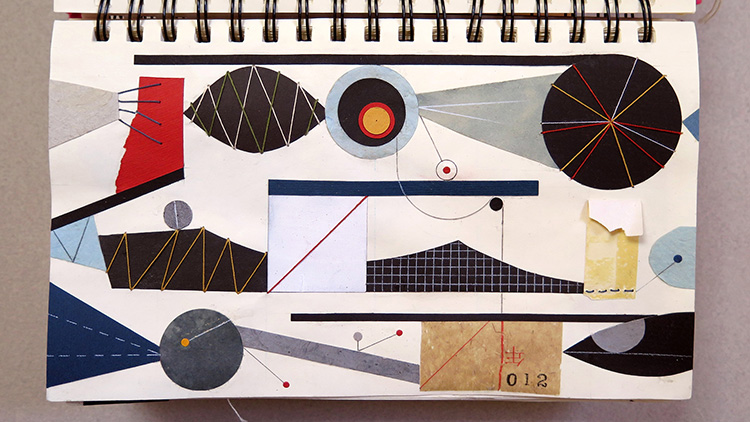
LV Sketchbook page 012 is a stylized map of McMurdo Station and its environs looking eastward. The yellow circle at top center indicates Mount Erebus, the world’s southernmost active volcano. To its right lies Mount Terror and to the left lies Mount Bird, two other prominent peaks on Ross Island. McMurdo’s main complex is the circled red dot circle to the lower right of Erebus.
The white square at the center is frozen-over McMurdo Sound and its ice runway. To the right lies Black Mountain and on the left lies the Golf Ball. Further left is Hut Point, home to Robert Scott’s Discovery expedition hut of 1901-04. No less importantly, the McMurdo Dry Valleys occupy the bottom third of the page.
Note to users: While minimal effort has been made to ensure map accuracy, some elements may actually be to scale and reflect correct locations in relation to one another.
February 28, 2017
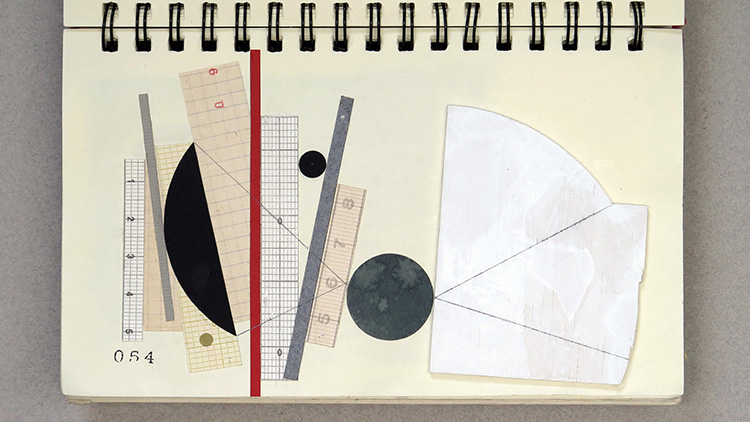
LV Sketchbook page 054 takes the study and measurement of Larsen C, Antarctica’s fourth-largest ice shelf, as its subject. Larsen C is under heavy observation as a rapidly advancing crack threatens to create one of the largest ice calving incidents on record. The rift now reaches over 110 miles in length, with some parts up to two miles wide. Once it reaches across the ice shelf — about another 20 miles — the break will create an iceberg the size of Delaware, among the biggest bergs ever recorded.
The separation is expected to occur within weeks or months, affording scientists their first proper look at an event of this magnitude. While most researchers expect the collapse of Larsen C itself to minimally affect global sea levels, the greater concern is whether the glaciers buttressed behind the ice shelf will accelerate towards the ocean. Removing an ice shelf is “like removing the cork out of the bottle,” says Adam Booth, a geophysicist at the University of Leeds.
Project MIDAS, a British Antarctic research project, has kept watch since the rift was first spotted in 2010. According to MIDAS scientists, this particular cracking is likely natural with no direct evidence of a link to climate change. General ice shelf decay along the Antarctic Peninsula however is still believed to be linked to Earth’s warming.
Most ice behavior information comes from observations from space, such as NASA’s Landsat 8 satellite. The imagery from Landsat 8 is held by the Global Land Ice Velocity Extraction (GoLIVE) project, a free data platform cataloging over 500,000 satellite-derived ice flow maps, with many thousands added each month. Imagery from the European Space Agency’s Sentinel-2 satellite will be added as well this year, potentially doubling the available quantity of data. The objective, says GoLIVE developer Mark Fahnestock, is a “model to reflect what’s happening now so you can anticipate how the ice will change in the future.”
My collage is composed of found and recycled material in keeping with the Long View project’s spirit of sustainability. Various graph papers signify measurement on the left and a slab of painted bass wood represents the imminent berg on the right.
January 31, 2017
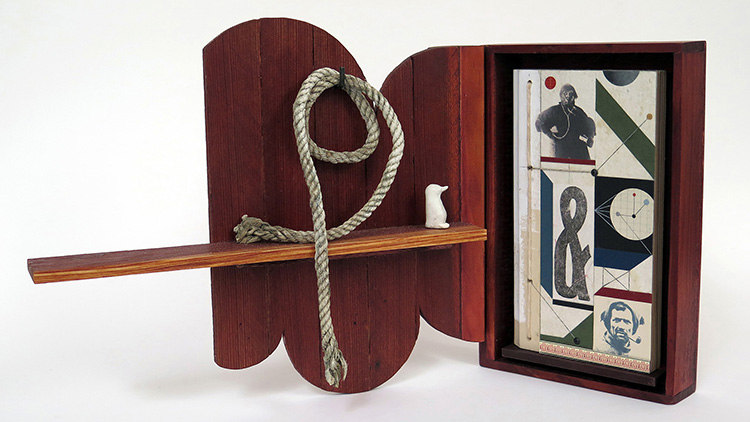
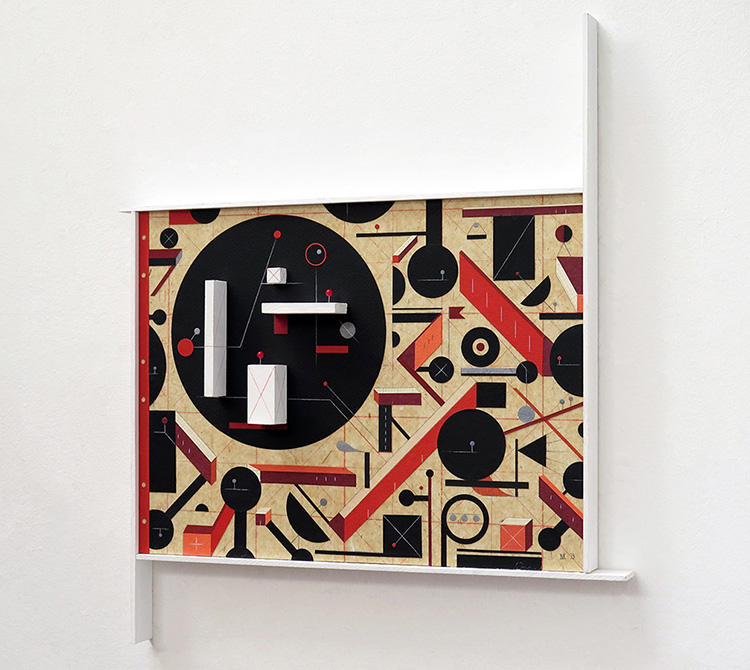
I’m excited to be participating in Art Above 66° 33”, a group exhibition that considers the issues, history and environment of the Earth’s polar regions. My new series of sculptures, collectively titled LV Installation II, marks my second exhibition of The Long View Project’s progress (the first being in 2011).
Installation II showcases eight pairs of mixed-media panels (titled ‘vignettes’) that incorporate discards from Antarctica to create a series of book-like compositions. Mounted on four wall shelf units, the compositions speak to Antarctic science, history, and environment with the larger goal of examining humankind’s relationship with the natural world over time. Vignettes 5 and 6 are pictured above.
Art Above 66° 33” runs through February 10, 2017 at the Augustana Teaching Museum of Art in Rock Island IL. The show was curated by Claire Kovacs and produced in collaboration with the Augustana Center for Polar Studies. The participating artists are Michael Bartalos, Cheryl Leonard, Oona Stern, Lisa Goren, Morten Hilmer, Ben Huff, Bridger Konkel, Andrea Polli, William Stout, Jonathan Harris, and Andrew Moore.
December 30, 2016
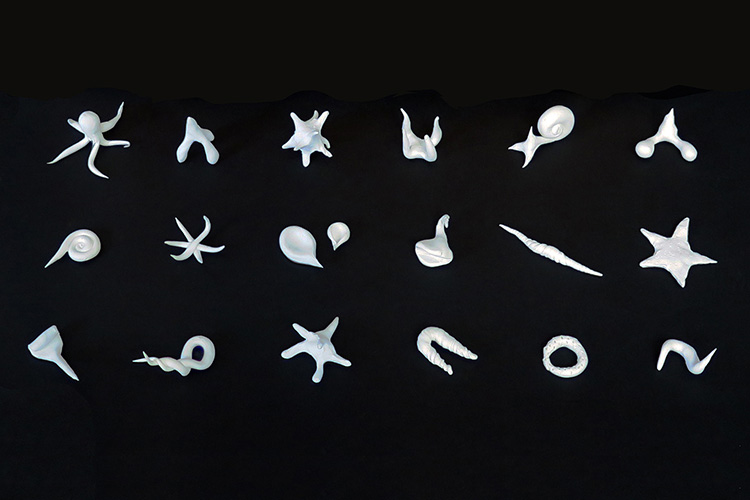
This recent Long View Study is inspired by a U.S. expedition’s discovery of diverse microbes thriving in a subglacial lake deep below the Antarctic ice sheet. In 2013, Montana State University researcher John Priscu and his WISSARD team found nearly 4,000 species of microorganisms in the cold, dark waters of Lake Whillans in West Antarctica. It was the first confirmation of life forms in the vast network of lakes that lie sandwiched between the continent’s land and the ice that covers it.
Deprived of sunlight, these microorganisms are fueled by chemosynthetic processes rather than photosynthesis. Some use the energy in the chemical bonds of ammonium to fix carbon and drive metabolic processes while others use the energy and carbon in methane to survive. Priscu and his team believe that the ammonium and methane may have been provided by decomposed organic matter deposited there hundreds of thousands of years ago when Antarctica was warmer.
WISSARD is one of three projects investigating the lakes that lie under the Antarctic ice. In February 2012, Russian scientists confirmed that they penetrated Antarctica’s Lake Vostok at a depth of 12,355 feet (over 2 miles). Despite being the first ever to probe a subglacial lake, they are yet to accurately analyze their samples due to borehole contamination. A British attempt to reach Lake Ellsworth, under a mile of ice, was called off in December 2012 due to equipment failure.
The scientists have vowed to press on, eager to eventually compare the contents of the three lakes. Lake Vostok’s waters are thought to take 10,000 years to renew as it is most sealed off from the surface. Lake Ellsworth may turn over in about 700 years, and the waters of Whillans, half a mile below the surface of the ice, is likely replenished every decade or so.
New discoveries may also shed light on how parallel life on other planets and moons can survive. As Priscu comments: “Europa has an icy shelf and liquid water beneath it, just like we find in the Antarctic system, which allows us to draw some conclusions about what we might find there. I’d love to be around when we finally penetrate that environment to look for life.”
My artwork consists of a grid of sculptural figurines that imagine a range of newly-discovered life forms. They were created in collaboration with my 11-year old son Bruno using white polymer clay. The collection is currently on view in the exhibition Art Above 66° 33’ at the Augustana Teaching Museum of Art from 2016 November 18 through 2017 February 10. In the show, this artwork is paired with a found Antarctic object to create one of fifty vignettes that will comprise the Long View project’s completion.
November 30, 2016
My newest Long View Study is inspired by Antarctic data collection. From the earliest days of polar exploration, scientists have recorded observations in the fields of biology, glaciology, geology, geophysics, metrology, and oceanography. Analog measuring devices and hand-inscribed ledgers were the order of the day for decades. Today’s technology has revolutionized the process, allowing researchers to gather and compare data over time with unprecedented efficiency and accuracy.
Earth observation satellites are a prime example. Scientists typically use them to monitor environmental changes over the long term to better understand and predict how Earth’s systems interact. Over Antarctica, they track shifts in sea ice, ozone depletion, animal populations, weather and other conditions using radar which allow study of inaccessible areas at day or night, regardless of cloud cover. Growing data sets reveal Antarctica’s role in the big picture, helping climate scientists assess, predict, and manage continued human impact on the natural system.
The artwork was created with cut paper, graphite, thread, and wood. It is currently on view in the exhibition Art Above 66° 33’ at the Augustana Teaching Museum of Art from 2016 November 18 through 2017 February 10. In the show, this piece is hinged with another panel to create a paired vignette — one of fifty that will feature in the Long View project’s completion.
October 31, 2016
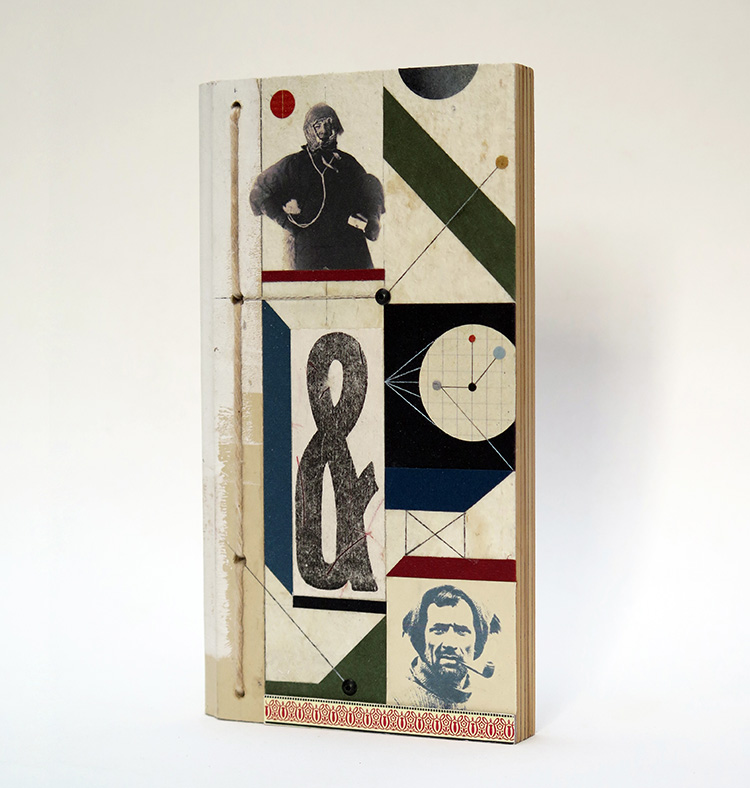
Long View Study No. 26 honors the Antarctic explorers Ernest Shackleton and Tom Crean. Shackleton has long been a household name, having been knighted even before his renown Endurance Expedition. But his loyal crew were no less heroic and essential to early Antarctic exploration. The best of them offered specialized skills, additional leadership, and put their lives on the line many times over. Tom Crean was one of those figures.
Born in County Kerry, Ireland in 1877, Crean enlisted in the Royal Navy at the age of 15 and went on to participate in three major Antarctic expeditions. His first was with Robert Falcon Scott’s 1901–04 Discovery Expedition, the largest scientific research effort and geographical exploration in Antarctica up till that time.
His second was Scott’s 1911–13 Terra Nova Expedition which claimed the lives of Scott and several of the crew. During this voyage, Crean walked 35 statute miles (56 km) solo across the Ross Ice Shelf to save his fellow explorer Edward Evans’ life for which he was awarded the UK’s Albert Medal for Lifesaving.
For his third and final Antarctic venture, Crean joined Shackleton’s Imperial Trans-Antarctic Expedition as as second officer. The voyage is an epic survival tale: After their vessel, the Endurance, was crushed and lost to pack ice, the ship’s party spent 492 days drifting on ice before landing on barren and uninhabited Elephant Island. There, Shackleton chose Crean as a member of the small crew that undertook — and completed — a brutal open boat journey of 800 nautical miles (1,500 km) to South Georgia to summon rescue for the stranded party.
Crean’s contributions to the Heroic Age of Antarctic Exploration earned him three Polar medals and great acclaim as an explorer. Following his retirement from the navy in 1920, he returned to his home town Annascaul where he and his wife opened a pub called The South Pole Inn. Crean died in 1938 at the age of 61, but the inn remains active to this day.
September 30, 2016
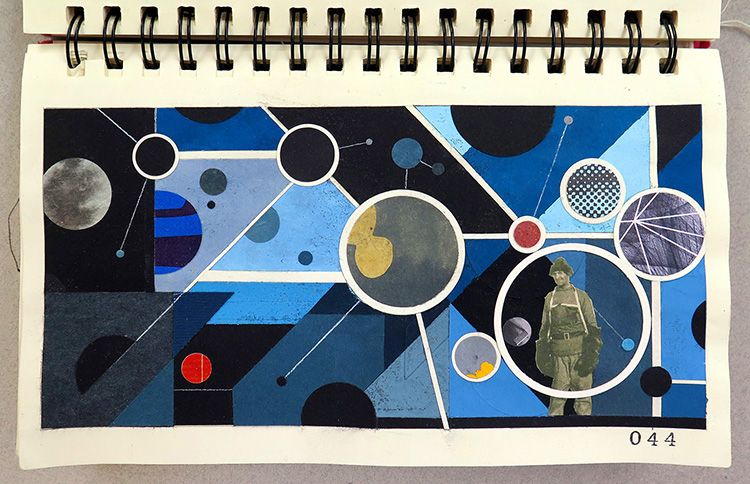
Sketchbook page 044 takes molecular biology for its subject, an area that fascinated the earliest Antarctic explorers. Today, molecular biologists and biochemists are at the forefront of studying Antarctica’s environmental changes in our era of global warming. The Southern Ocean around the Antarctic Peninsula is predicted to rise between two and five degrees Celsius over the next two centuries, bringing radical change to marine organisms ranging from single-celled microbes to fish. Presently these Antarctic creatures’ body temperatures fall in a very narrow range — from -1.9 to +2 degrees Celsius — to which they have adapted over a period of 50 million years. Sudden temperature increases will bring a shock to their physiological systems with unknown consequences.
To gain insight into how warming waters might affect the development of fish embryos and their growth after hatching, marine biologists are raising various species in both current water temperatures and at the projected higher temperatures. In the process, they analyze the fishes’ physiology and biochemistry using state-of-the-art lab equipment. One instrument, a high-throughput automatic DNA sequencer, allows scientists to observe organisms from their basic biological building blocks using digital data and visualization tools. Through such technology and experimentation, researchers aim to provide policymakers and the public with data to inform decision-making in regards to climate change and protecting life in Antarctic waters.
May 30, 2016
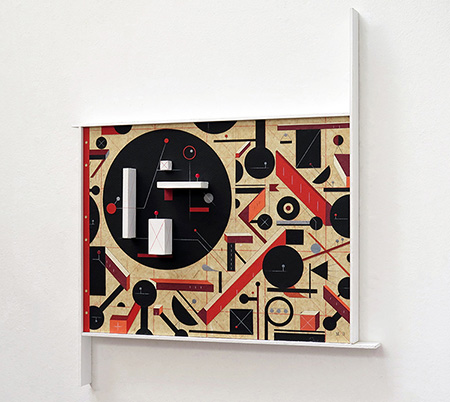
An ambitious multiyear program of science and infrastructure powers China’s Antarctic Kunlun Station. Details on my Long View blog hosted by the California Academy of Sciences.
May 19, 2016
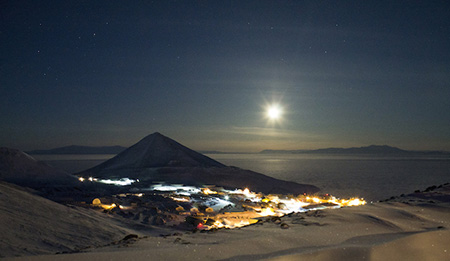
I’m excited to be featured in an article on VICE’s The Creators Project about the NSF’s Antarctic Artists and Writers Program along with artist Helen Glazer.
April 29, 2016

Researchers are monitoring the West Antarctic Ice Sheet’s mass balance to estimate rising sea levels. Learn more on my Long View blog.