Art Made Here 2012
August 6, 2012
I’m recently back from Chiapas, Mexico, where my colleague Kelynn Alder and I led our latest round of community art workshops called Art Made Here. Formerly known as Lacandón Art Workshops, we re-named the program last year upon expanding beyond the Lacandón jungle to include the Central Highlands region.
This year we offered three sets of tallers: drawing and watercolors for the indigenous Mayan jungle community of Lacanjá; mural painting with La Casa de las Flores in San Cristóbal de las Casas, and drawing and watercolors with Club Balam, also in San Cristóbal.
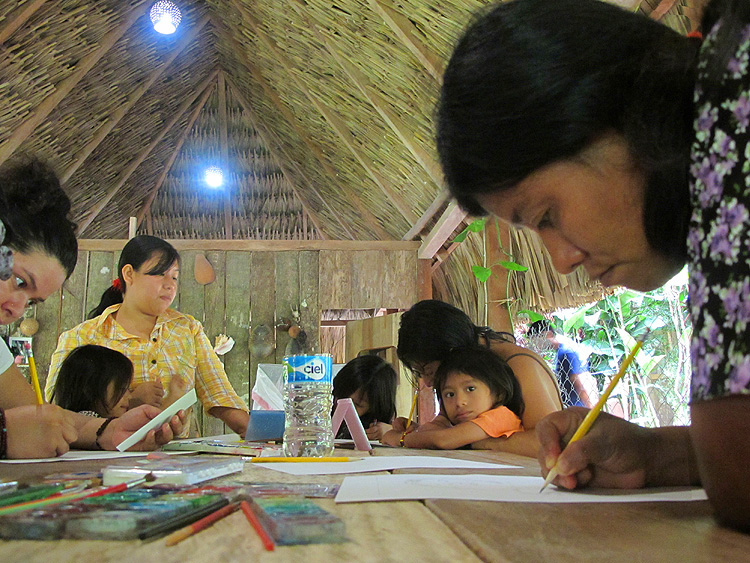
Lacanjá, 2012.
Our first stop was Lacanjá, a Lacandón settlement we routinely visit in Chiapas. It’s situated on the eastern side of the Montes Azules Biosphere Reserve near Bonampak, hosting a rich array of wildlife and vegetation. These natural resources, so important to shaping Lacandon traditional culture, were the theme of this year’s Lacanjá workshops.
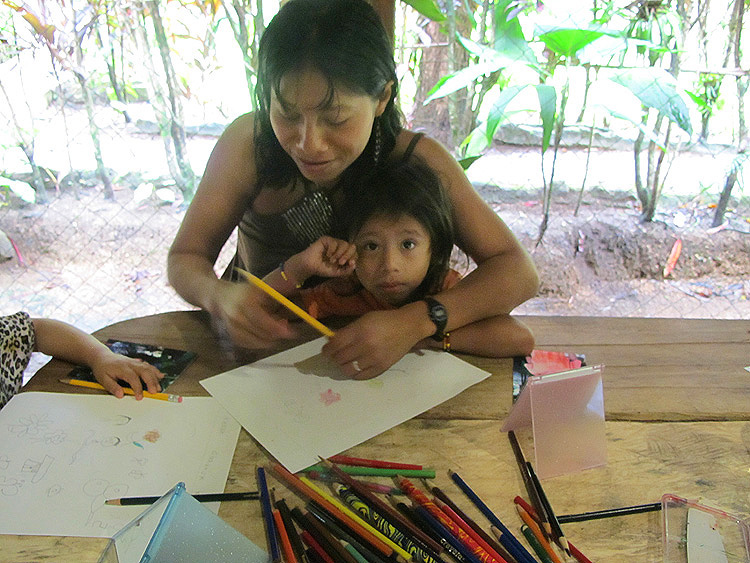
Lacanjá, 2012.
We addressed the theme with a self-portrait project that asked participants to represent themselves in their natural environment. We began with photographing everyone in a setting of their choice and printing the pictures on a portable printer as reference for the group to draw from.
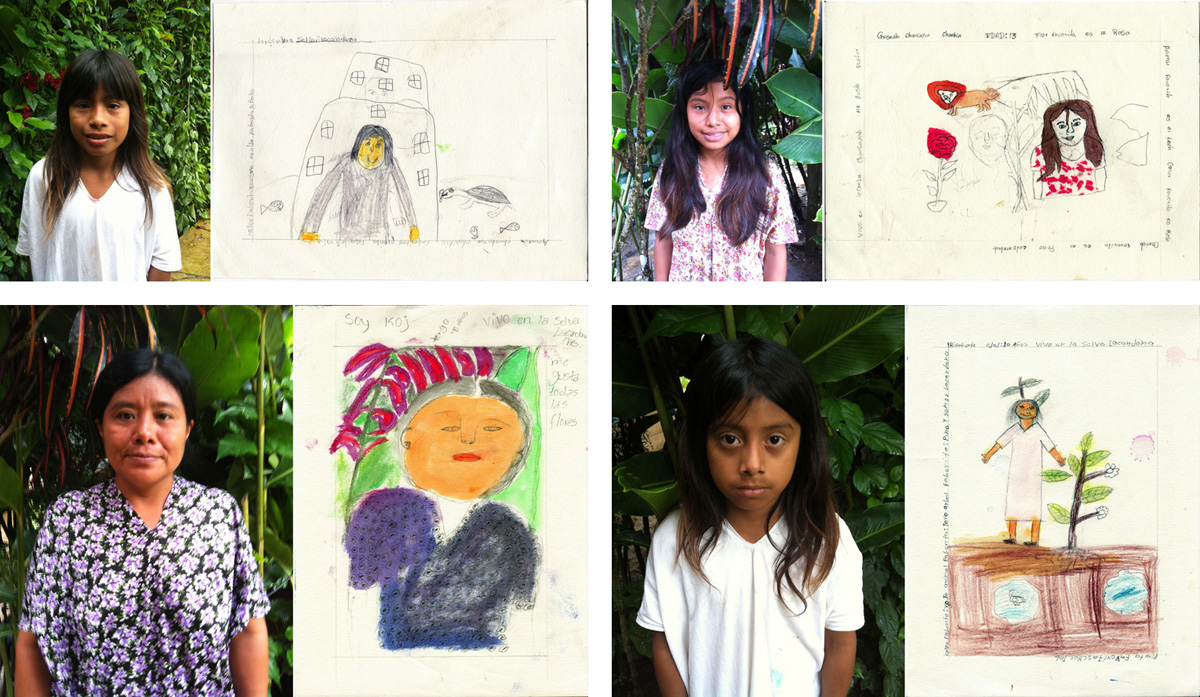
Selections from the Lacanjá workshops.
Many featured themselves prominently in the artworks, adding words about their favorite plants and animals. Others rendered themselves as diminutive figures in dominant landscapes. Others still represented themselves as jungle creatures. Regardless of approach, the Lacandon habitat significantly shaped each portrait.
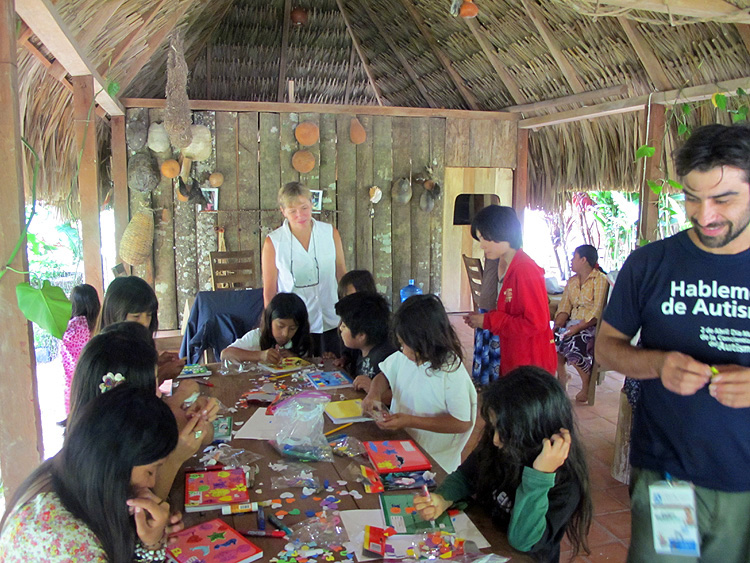
Lacanjá, 2012.
In wrapping up the workshop, we distributed blank notebooks to each participant to personalize with their printed photo, stickers, artwork and writing. We customarily leave school and art supplies behind as Chiapas suffers the country’s highest rate of poverty and illiteracy.
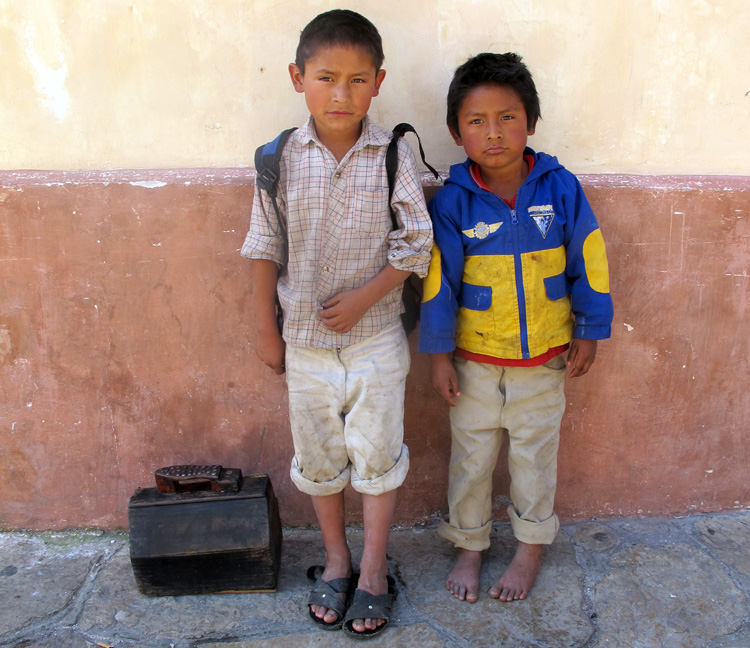
Shoeshine boys, San Cristóbal de las Casas.
From Lacanjá we continued on to San Cristóbal de las Casas to hold workshops with two of our partner organizations: La Casa de las Flores and the Lower East Side Girls Club‘s Club Balam.
La Casa de las Flores is a safe refuge for the town’s working street children. It offers rest, play, and learning space for kids who have little or no opportunity for school or creative activity. Most eke out a living as vendors and shoeshine boys; many come from broken homes, and some live on the streets full time.
The facility’s founder is Claudia Castro, a true saint in San Cristóbal. Her note from the director speaks to her generosity and commitment, but watching her in action is to fully appreciate her ability to create change on the ground. She works with kids tirelessly to build a community of mutual trust, respect and friendship. In doing so, her network of support extends to the most invisible and vulnerable youngsters on the streets. This is a lifeline in a region where child prostitution and trafficking are real and serious issues.
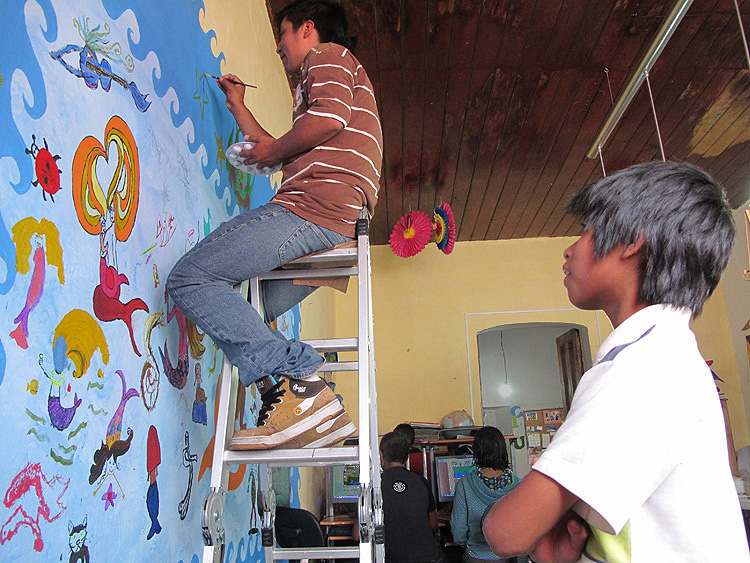
Mural in progress at La Casa de las Flores.
Eager to help Claudia, we gladly accepted her invitation to start a mural with the kids in the building’s library space. The theme was mermaids, inspired by a poem that would appear on the wall in Spanish, English, and Tzotzil. We began with painting a blue seascape area which the community populated with an array of sea maidens over the course of our week in San Cristóbal.
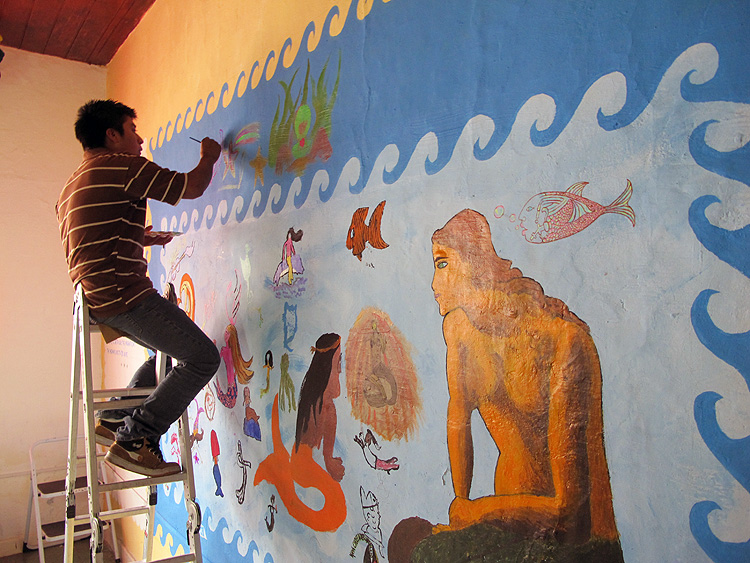
Mural in progress at La Casa de las Flores.
By the time of our departure the sea was nearly full with inventive creatures, inviting future contributors to leap beyond the waves to cover the entire wall. The mural’s evolution will be exciting to follow since it’s an open-ended project, allowing work to continue indefinitely.
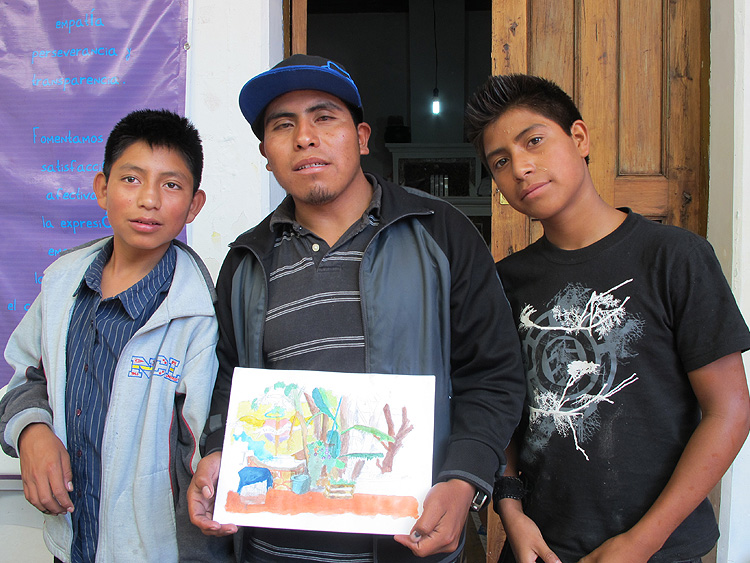
Victor with his artwork, La Casa de las Flores.
A great pleasure of leading workshops is providing exceptionally talented youngsters with the means and encouragement to develop their artistry. At La Casa de las Flores we met such a young man called Victor. When not working in the streets, he draws voraciously, copying masterworks from art books that Claudia collects for him. Impressed by his dedication, we assigned him the centerpiece of the mural. He chose to paint Copenhagen’s famous Little Mermaid statue, strategically placing her to oversee most of the seascape. We look forward to seeing more of Victor’s art on our return, confident that his talent and motivation will take him far.
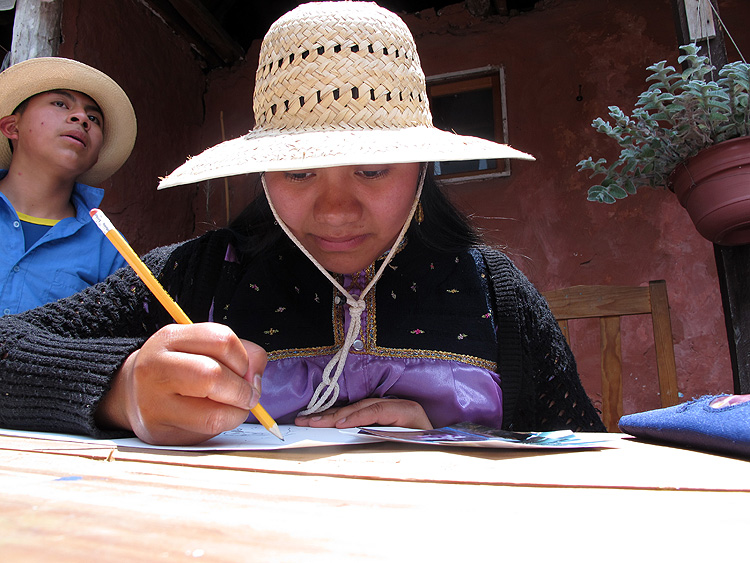
Club Balam, 2012.
Concurrent with the mural project, we led self-portrait workshops with Club Balam, the Chiapas chapter of the Lower East Side Girls Club of New York. The Girls Club is our fiscal sponsor which accepts tax-deductible donations on Art Made Here’s behalf and helps us promote our program.
As in Lacanjá, we took the natural environment for our workshop theme. It’s a noteworthy topic as Chiapas has the highest rate of deforestation of any Mexican state and San Cristóbal continually loses its native trees and endemic wildlife to strip mining, the area’s most profitable industry.
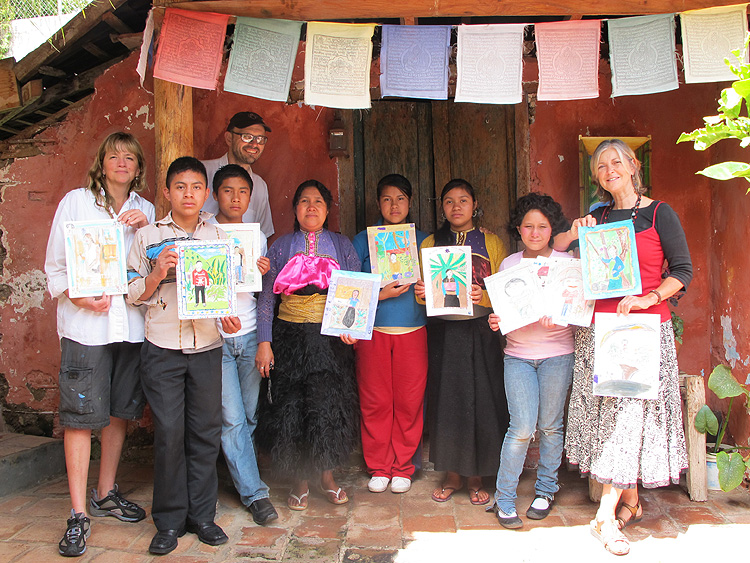
Club Balam, 2012.
Again, we started by photographing each participant in a setting of their choice and printing the pictures on the compact printer for reference. The kids then described themselves and their environment through drawing, painting, and writing. Our objective was to encourage personal expression with which to amplify awareness and appreciation for the local habitat.
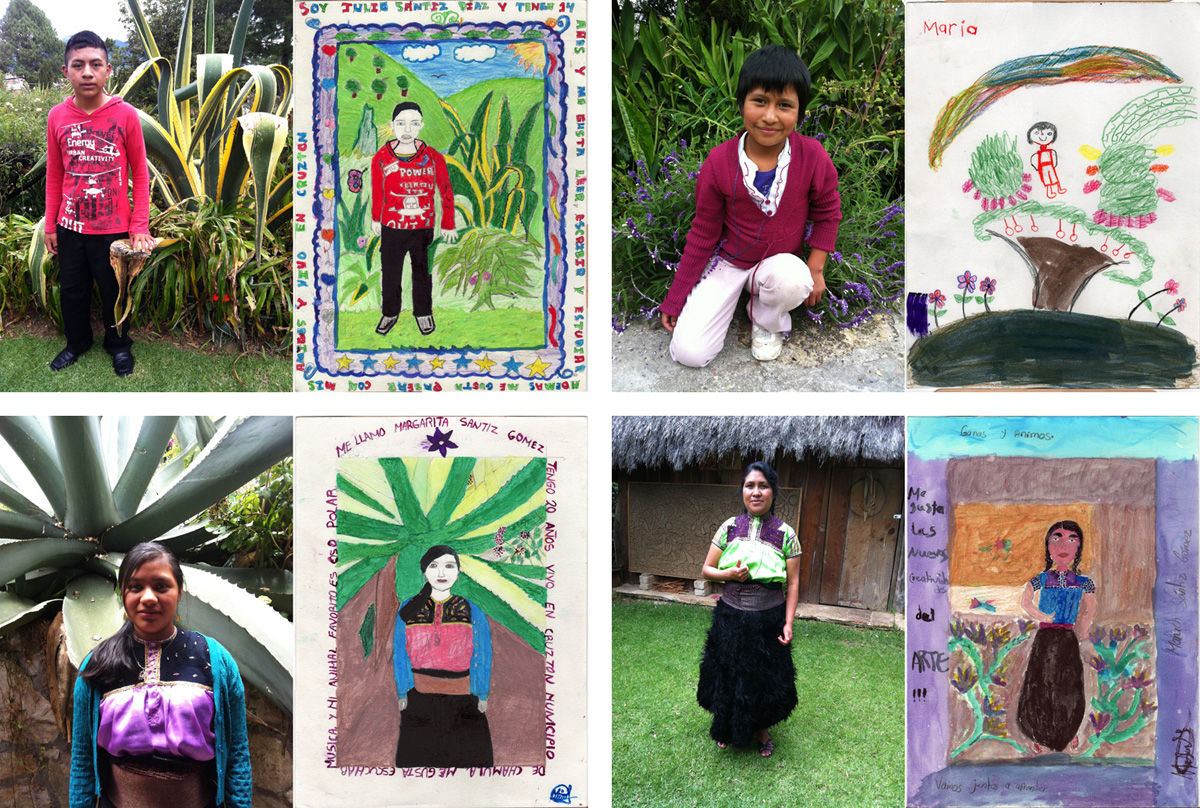
Selections from the Club Balam workshops.
Taken together, the Lacanjá and San Cristóbal self-portraits reveal the shared values held by Chiapas’s varied indigenous populations. From the Lacandón Maya to San Cristóbal’s Tzotzil and Tzeltal ethnic groups, all depend on the same natural resources and assurances of a clean, sustainable future.
Kelynn and I are now working to mount an exhibition of the art and photos and to publish them in a limited edition to benefit the communities and our program. More news as it happens. In the meanwhile, additional images from this and past years’ workshops can be seen at Art Made Here’s gallery pages.
We’d like to thank Margarita Leonard and Lyn & Dave Pentecost for facilitating the workshops with Club Balam, and great appreciation to Claudia Castro for inviting us to help make a difference at La Casa de las Flores. We’re grateful to have gained family in a part of the world that we never quite seem to get enough of.
Also, we extend our heartfelt thanks to all our generous donors who came through to help make Art Made Here a reality in Chiapas in 2012.
Information about helping to support our program is here.